2026-09-25
Outdoor spaces often bring together tables, chairs, walkways, planting areas, walls, and overhead shade. The way these elements are arranged can affect how easily people move, sit, open an umbrella, or adjust the amount of shade during the day. A Crank Lift Umbrella adds another consideration because its opening and height adjustment require accessible space around the central pole.
Planning therefore involves more than placing an umbrella over a table. The canopy needs to correspond with the furniture below it, while the crank needs to remain reachable and the raised canopy needs enough clearance above the seating area. Weather exposure, regular handling, storage, and maintenance can also influence where the umbrella is positioned.
Looking at these factors together can make outdoor layouts easier to organize. Instead of treating shade as an isolated feature, it can be considered as part of the wider relationship between furniture, movement, operating space, and outdoor conditions.
The size of an umbrella should relate to the furniture and activity area beneath it. A small table may require only a limited shaded area, while a longer table can extend beyond the practical coverage of a smaller canopy. The position of the table also matters because people tend to use the space around its edges as much as the area directly underneath.
A useful planning approach is to consider the table and its surrounding seating as one area. Chairs need room to move backward, people need space to walk around them, and the canopy should remain positioned where it provides useful shade without interfering with nearby features.
For example, a table placed close to a wall has different requirements from one positioned in an open patio. The available side space can influence where the pole is placed and how far the canopy extends.
| Outdoor arrangement | Planning point |
|---|---|
| Compact table | Keep the canopy aligned with the usable seating area |
| Long table | Consider how far the shaded area extends beyond the table |
| Table near a wall | Check side clearance before positioning the umbrella |
| Several tables together | Consider overlap between individual shade areas |
The aim is not simply to choose a larger canopy. A suitable arrangement comes from matching the shaded area with the actual space people occupy.
A crank-operated umbrella needs accessible space around its operating point. This becomes particularly important when the umbrella is installed close to dining furniture, railings, walls, planters, or other fixed objects.
A table may fit beneath the canopy while leaving little room for a person to reach the crank comfortably. Chairs can create a similar problem when they are placed directly beside the pole. Moving the entire table every time the umbrella needs adjustment can make routine use less convenient and may disturb the surrounding layout.
The position of the crank should therefore be considered while arranging furniture. Before placing the umbrella, it helps to look at:
These considerations are particularly relevant in compact patios. A small change in the position of a table can create more room for operation without changing the overall seating arrangement.
An umbrella canopy does not occupy space only across the horizontal plane. Its height also affects the relationship between the shade and the furniture below it. Tables, chairs, decorative structures, and overhead features can all influence the appropriate position of the canopy.
When the canopy is raised or lowered, its relationship with the seating area changes. A lower position may bring the shade closer to the people beneath it, while a higher position can provide more open space around the furniture. The available overhead clearance should also be considered before the umbrella is installed.
This is particularly relevant where an outdoor area includes a roof edge, pergola, tree branches, lighting fixtures, or other overhead elements. The umbrella needs enough room to operate without repeatedly contacting surrounding objects.
The planning process can therefore include three related questions:
Considering these points together helps prevent a layout in which the umbrella fits visually but becomes difficult to adjust during normal use.
Outdoor umbrellas may be adjusted according to changing sunlight, seating arrangements, or periods of use. Because of this, the operating mechanism should be considered part of the everyday layout rather than something used only during installation.
The crank provides a controlled way to open or close the canopy and can also make height adjustment part of the routine. Its usefulness depends partly on whether people can approach it without moving surrounding furniture.
Daily operation can involve several situations. A patio may begin with the umbrella closed, followed by opening it when the seating area is occupied. Later, the canopy may need to be adjusted as the position of the sun changes. At the end of use, the umbrella may be closed again before the area is cleared.
This sequence shows why the operating area deserves attention during planning. If access is blocked by a chair, table edge, wall, or decorative element, a simple adjustment can become an awkward task.
For shared outdoor spaces, the operating position can also affect how different users interact with the furniture. A clear and predictable arrangement reduces the need to rearrange nearby objects whenever the canopy is opened or closed.
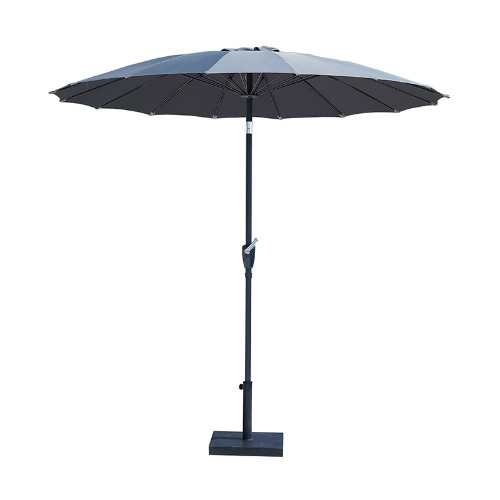
Outdoor shade equipment is exposed to changing conditions that can affect how it is handled. Sunlight, rain, moisture, and wind each create different considerations for the surrounding space.
Rain can leave the canopy and other exposed components damp. If the umbrella is closed while moisture remains trapped against surfaces, drying can become more difficult. A suitable routine can include allowing wet surfaces to dry when conditions permit and keeping the umbrella stored appropriately when it is not in use.
Wind requires a different approach. An open canopy can create movement when exposed to changing airflow, so the surrounding layout should allow the umbrella to be closed without obstruction. Furniture, walls, railings, and narrow passages can make this process less convenient if they are positioned too close to the umbrella.
| Weather condition | Practical planning consideration |
|---|---|
| Strong sunlight | Consider how shade position changes during outdoor use |
| Rain | Allow exposed surfaces to dry before extended storage |
| Moist conditions | Pay attention to areas that remain damp after use |
| Windy conditions | Keep the closing path and surrounding space unobstructed |
Weather planning is therefore connected to both placement and routine handling. An umbrella positioned in an easy-to-access area is generally easier to close, inspect, and store when outdoor conditions change.
Regular handling can gradually reveal changes in the operating mechanism. A crank that feels different from normal, unusual resistance during movement, or difficulty keeping the canopy in its intended position can indicate that inspection is needed.
Maintenance does not have to involve complicated procedures. Routine attention can focus on visible and accessible areas, particularly those involved in opening, closing, and raising the canopy.
Useful checks include:
If an umbrella becomes difficult to operate, forcing the crank can place additional strain on the mechanism. Stopping the operation and identifying the cause is generally more appropriate than applying increasing force.
Storage is also part of maintenance. When an outdoor umbrella is not being used for an extended period, its storage location should protect it from unnecessary moisture and contact with objects that could damage the canopy or operating components.
Commercial outdoor seating introduces additional planning considerations because the same area may be used repeatedly throughout the day. Restaurants, cafés, hospitality spaces, and other shared patios may contain several tables, multiple walking routes, and staff access points within one outdoor zone.
In these settings, the position of each umbrella can affect the arrangement of neighboring furniture. A canopy may provide shade for one seating group while its pole, crank, or operating area interacts with another table.
Staff access is another consideration. If umbrellas need regular adjustment, the operating mechanism should remain reachable without forcing staff to move occupied tables or interrupt pedestrian movement.
A commercial layout can be considered through several connected areas:
These factors become more interconnected as the number of seating areas increases. A layout that works for one table may need to be reconsidered when several umbrellas are positioned within the same patio.
Planning an outdoor umbrella area works more effectively when the individual elements are considered together. Canopy coverage needs to correspond with the table, while the pole and crank need sufficient operating space. The canopy height must also work with the available overhead clearance.
The surrounding environment then adds another layer. Walls, railings, plants, lighting, walkways, and neighboring tables can all affect where an umbrella can be positioned and how easily it can be operated.
A practical planning sequence can include:
The same approach can be applied to both residential patios and shared commercial spaces, although the surrounding conditions may differ. The key consideration is the relationship between the umbrella and everything around it.
When these relationships are considered before installation, outdoor shade becomes easier to incorporate into the wider layout. The result is a space in which seating, movement, adjustment, weather response, and maintenance can work together without relying on frequent changes to the furniture arrangement.
Related Products
Contact Us for More Details
Don't hesitate to contact when you need us!
Contact Information
Add:
No.5-58(Building1&2in factory ) Kongao village, DatianDistrict, Linhai, Zhejiang, China
Phone:
+86-13958586110
Tel:
+86-576-89398116
E-mail:
Product Category
QR Code
Join our community and stay connected

Wholesale Outdoor Parasol Umbrella Factory

 English
 中文简体
中文简体
 Español